
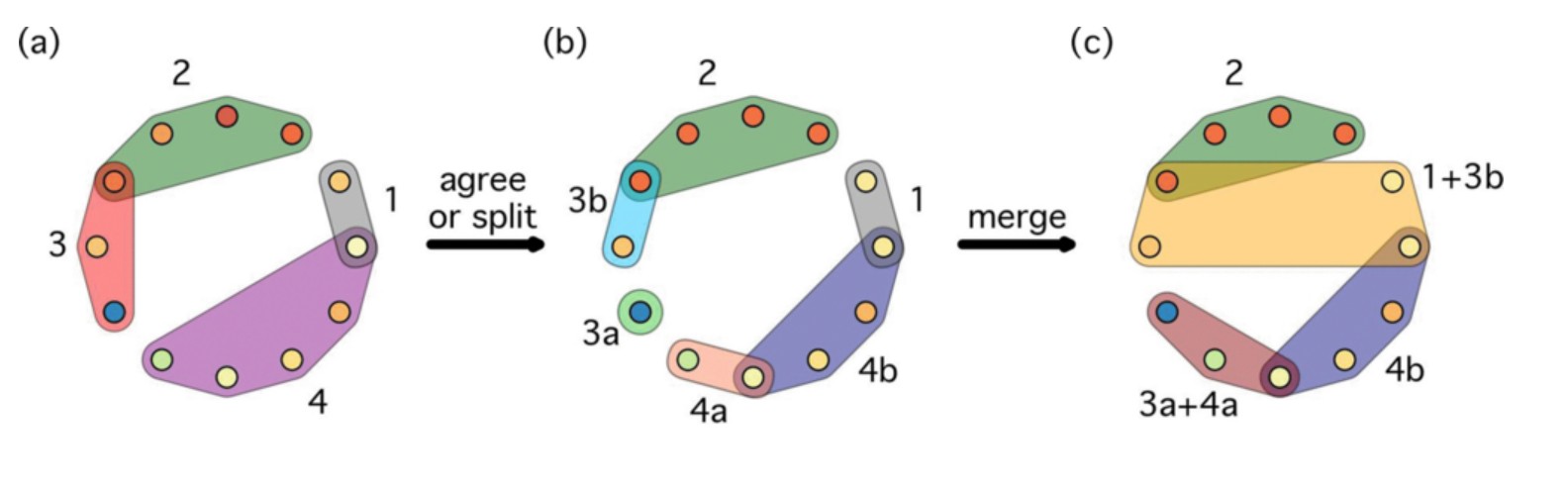
In modern interconnected societies, opinions and beliefs can quickly spread across large populations, giving rise to collective behaviors such as the adoption of social norms or polarization. The interest in these phenomena led to the formulation of many models aiming at reproducing relevant emergent properties from simple mechanisms of interactions between individuals. In particular, opinion dynamics models mimic how the opinions of individuals on a given topic may evolve when they interact, and study the conditions for global consensus or polarization. Most models assume that these interactions occur between pairs of agents, typically on a fixed network structure. However, discussions leading to opinion changes can occur in groups, and these groups can also undergo adaptive changes and modifications if their members disagree. Here, we propose a bounded confidence model of opinion dynamics taking into account these two mechanisms: A group discussion can lead to a global agreement among all group members, if their opinions are close enough, while a strong divergence of opinions within a group leads to its splitting, followed by merging of the resulting subgroups with other groups. We systematically study the outcome of this model as a function of the tolerance of agents for reaching an agreement. Strikingly, adaptivity seems to suppress important effects induced by group interactions, and to restore a phenomenology close to the one obtained with pairwise interactions. We show that adaptivity, which allows the formation of large groups, prevents the transition to a fragmented state at small tolerance. Moreover, it restores a phase transition from a polarized state to consensus, which would otherwise disappear due to group effects in a nonadaptive bounded confidence model with group interactions. Overall, our work shows that both adaptivity and group interactions shape the structure of social ties and the global opinion dynamics in a population.